
Gold price in Mumbai's physical market on Friday fell 31.1 per cent or Rs 1,351 to close at Rs 41,848 per 10 gramme. Friday's fall in per cent terms is worst after November 2015 and, in absolute terms, the worst after August 2013. Silver prices fell Rs 2,255 to close 5 per cent lower at Rs 43,085 per kg on Friday.

Diesel rates had gone up by Rs 12.55 a litre between June 7, when oil firms resumed revising prices in line with cost, and July 25.

In the Financial year 2013-14 there were encouraging signs on the foreign trade front as India's trade deficit recorded a sharp fall.

"Oil prices are not going to come down. The era of cheap food is over and prices are likely to remain high for at least the next 10 years," World Bank South Asia Region Vice-President Praful Patel told PTI. He said the current situation has 'caught the whole world by surprise' and the crisis was due to a combination of factors, he said.

Consolidated earnings for oil-to-telecom conglomerate Reliance Industries (RIL) may report sequential weakness, and modest year-on-year (Y-o-Y) growth in the June 2024 quarter (Q1FY25), said analysts. Lower refining margins are expected to moderate gains made from other businesses. RIL is slated to report its financial performance for Q1FY25 on July 19.

RBI in wait and watch mode as several risks to inflation continue to exist including a sudden reversal of food prices and oil price volatility.

"Under different scenarios, we see the impact of higher crude prices ranging from $25 billion to a maximum of $50 billion on the oil import bill. The increase in the oil import bill will also affect the current account deficit," economic affairs secretary S C Garg said in a conference on Friday.

Retail inflation declined to a one-year low of 5.72 per cent in December 2022, mainly due to softening prices of food items, according to official data released on Thursday. The Consumer Price Index (CPI) based retail inflation was at 5.88 per cent in November 2022 and 5.66 per cent in December 2021.

In the last 3 months, rupee has depreciated 16% against dollar.

India will surpass China as the world's fastest growing economy in the next 2-3 years, says RIL chairman Mukesh Ambani.

Fast-moving consumer goods (FMCG) sales continued to be lower in June compared to May with urban sales witnessing a steeper decline than rural. Sales of goods from shampoos to biscuits stayed lower due to inflationary pressures on commodities. This pushed consumer companies to continue taking price hikes, thus impacting demand, according to data by Bizom.

The primary and immediate impact of a depreciating rupee is on the importers who will have to shell out more for the same quantity and price. However, it is a boon for the exporters as they receive more rupees in exchange for dollars. The rupee depreciation has wiped away some of the gains that would have accrued to India from international oil and fuel prices dropping to pre-Ukraine war levels.

The wholesale price-based inflation rate declined to (-) 4.12 per cent in June on easing prices of food, fuel and manufactured items. The wholesale price index (WPI) based inflation in May was (-) 3.48 per cent. In June last year, it was 16.23 per cent.

According to estimates, if the companies are not allowed to raise petrol rates at least Rs 5 a litre by the first fortnight of September, they might begin to suffer underrecoveries on this decontrolled auto fuel, too -- for the first time this financial year.

Sensex heavyweight Reliance Industries fell 2.76 per cent. In percentage terms, major laggards were Yes Bank, Indusind Bank, RIL, ICICI Bank, HDFC and Axis Bank -- plunging as much as 6.62 per cent.

India's crude oil imports are coming in from a changing mix of countries, with the top three accounting for around 60 per cent of total imports. Russia emerged as the largest source of crude oil imports for India in June, as per the latest available data from the Organization of the Petroleum Exporting Countries (OPEC). The data which is released with a lag, showed that Russian imports accounted for 24 per cent of the total crude imports into the country.

The government on Thursday more than doubled the price of natural gas that is used to produce electricity, make fertilisers, turned into CNG and piped to household kitchens for cooking, on the back of a spike in global energy prices. The price of gas produced from old regulated fields, such as the nation's largest gas field of Bassein of ONGC, will rise to a record high of $6.10 per million British thermal unit (mmBtu) from the current $2.90 per mmBtu, according to the oil ministry's Petroleum Planning and Analysis Cell (PPAC). The new price, which is likely to result in a hike in CNG and piped cooking gas rates, will be for six months beginning April 1.
India's economy continues to be robust, but downside risks such as rising crude oil prices, adverse weather conditions, and the global banking crisis outweigh the upside potential in gross domestic product (GDP) growth in the current financial year (FY24), the finance ministry said on Tuesday in its Monthly Economic Review for March. "We reiterate that downside risks to our official forecast of 6.5 per cent for real GDP growth in FY24 dominate upside risks," the review said. "Opec's surprise production cut has seen oil prices rise in April, off their lows of low-seventies per barrel in March.

Sentiments took a hit after broader Asian markets weakened, following a renewed sell-off on Wall Street on Tuesday as energy shares dropped after crude oil prices plunged to a 13-month low amid weak earnings and US-China trade disputes, fuelling worries about economic growth

Amid fast-depleting forex reserves, the Finance Ministry on Wednesday signalled that it was not in favour of selling the dollar to defend any particular level of the rupee. "Let it (rupee) reach whatever levels it has to reach. We can't fritter away reserves on defending some artificial, imaginary rate of exchange," a senior finance ministry official told Business Standard. Forex reserves declined to a near two-year low of $545.65 billion as on September 16, down $85.88 billion from the level that existed on February 25, a day after Russia invaded Ukraine.

The NSE Nifty too ended 58.60 points, or 0.54 per cent, higher at 10,967.30 after shuttling between 10,985.15 and 10,928 during the session.

For the first time, the rupee declined to the low level of 80 against the US dollar in intra-day spot trading on Monday before ending the session 16 paise lower at 79.98 amid a surge in crude oil prices and unrelenting foreign fund outflows. At the interbank forex market, the local unit opened at 79.76 against the greenback but lost ground to touch the psychological low mark of 80 against the American currency. The local unit clawed back some lost ground and closed at 79.98, registering a fall of 16 paise over its previous close.

"At the moment, the fall is arrested (and it) is very clear. The growth is happening. We will only be looking at the steady growth. It may be slow but steady," Commerce Minister Nirmala Sitharaman told reporters in New Delhi.

Maruti Suzuki was the biggest gainer among Sensex scrips, rising 5.89 per cent, followed by M&M up 5.29 per cent.
An independent central bank, free from political interference, is in the best position to ensure low and stable inflation over time.

Gold as well as crude oil prices surged, with the latter even crossing the $103 per barrel mark. The domestic stock market opened deep in the negative territory, tumbling over 1,700 points and eroding investors' wealth by more than Rs 8 lakh crore in less than an hour of start of trade on Thursday.

Jim Rogers, chairman of Rogers Holdings, tells Puneet Wadhwa that the US bond market that hit bottom in 1981 and has been in a bull-run since then, is coming to an end.

Inflation in food articles during May stood at 1.13 per cent, as against 2.55 per cent in April.
RBI will be cautious easing rates further given oil price uncertainties

The Reserve Bank is unlikely to cut the benchmark interest rate in its forthcoming bi-monthly monetary policy review later in the week as retail inflation is still a cause of concern, and there is a possibility of the Middle East crisis deteriorating further, impacting crude oil and commodity prices, say experts.

Sensex closed over 118 points down on Thursday.

Traders said falling crude prices in the global market was a big boost for the economy as it lightens the country's import bill burden, eases inflation and current account deficit concerns.

It is true that the rupee is at least becoming less strong, albeit slowly.
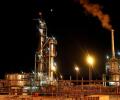
India's import of discounted crude oil from the Russian Federation hit an all-time high in May, with state-run refiner IOC becoming the biggest importer of Russian oil, relegating Reliance Industries to the second place, trade and shipping data show. Indian imports of Russian oil, accounting for over 46 per cent of its total crude oil imports in May, have grown after strong backing by New Delhi, with state-run refiners powering imports of discounted crude. Discounts on Russian oil average around $10 a barrel, said an official from a state-run refiner. IOC's May purchases rose by 64 per cent on the month, and accounted for half of its total crude imports last month, ship tracking data show.

Investor wealth worth over Rs 13.44 lakh crore was wiped off on Thursday as the domestic equity markets tumbled along with global risk assets, after Russia launched military operations against Ukraine. Amid intensifying rout in the global financial markets, the 30-share BSE Sensex plummeted 2,702.15 points or 4.72 per cent to end at 54,529.91. The carnage on Dalal Street eroded investor wealth worth Rs 13,44,488.54 crore, taking the total market capitalisation (m-cap) to Rs 2,42,24,179.79 crore on the BSE.

Kotak Mahindra Bank was the biggest loser in the Sensex pack, sliding 2.68 per cent, followed by Tech Mahindra, Mahindra & Mahindra, Axis Bank, Hindustan Unilever, Tata Motors, Tata Consultancy Services, Bajaj Finserv, Bajaj Finance, Nestle and Titan. In contrast, NTPC, Power Grid, Larsen & Toubro, HDFC, Reliance and HDFC Bank were the gainers.

Since August, petrol price has been cumulatively cut by Rs 9.36 per litre.

Exports to India's key markets - the US, the United Arab Emirates, China, Singapore, Bangladesh and Germany - witnessed a sharp decline, resulting in a 12.69 per cent contraction in outbound shipments during the first month of the current financial year, commerce department data showed. India's biggest export market - the US - with 17 per cent share witnessed 17.16 per cent contraction at $5.9 billion in April. This was followed by the United Arab Emirates (UAE) that saw 22.09 per cent decline at $2.23 billion exports.

The 50-share NSE Nifty settled lower by 76.05 points, or 0.88 per cent, at 8,615.25

The brokerage earnings estimate for the January-March 2024 quarter (Q4FY24) for Nifty 50 companies hints at a slowdown in corporate profit growth while revenue increase is likely to be in low single digits as in the previous two quarters. According to various brokerage estimates, the companies' combined net profits are expected to grow 3.1 per cent year-on-year (Y-o-Y) in Q4FY24, the slowest in the last five quarters. For comparison, the index companies' combined net profits were up 8.2 per cent Y-o-Y in Q3FY24 and 3.4 per cent Y-o-Y in Q4FY23.
